


March 11, 2026
AI LEARN focuses on the interactions between humans and artificial intelligence (AI). The new national centre is dedicated to understanding and shaping the human dimensions of human-AI interaction and adoption for sustainable, inclusive & responsible integration across both public and private sectors and for all citizens.
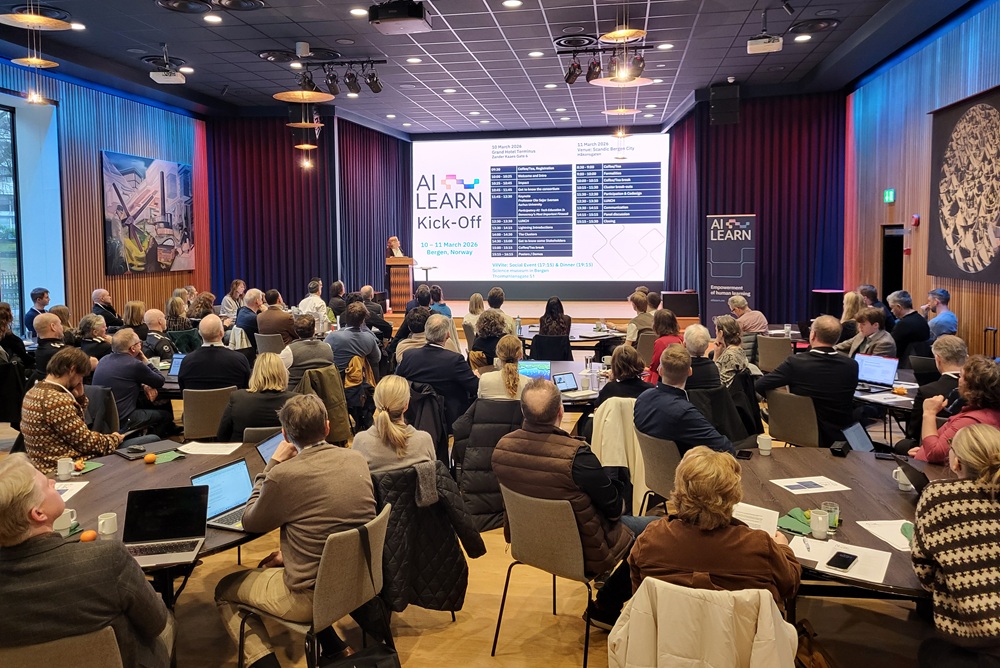
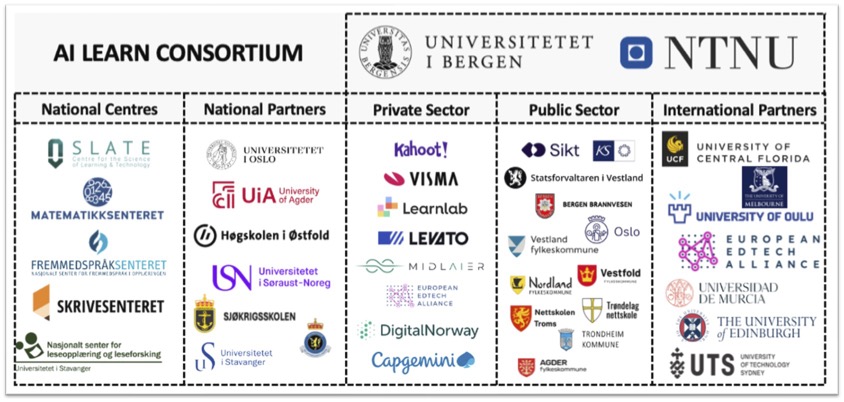
The Kick-Off event for AI LEARN was held at Grand Hotel Terminus and the VilVite Science Centre (an associated partner of AI LEARN) on March 10th, and Scandic Bergen City on March 11th. Representatives of most of the 35 AI LEARN partners - from academia and the private and public sectors - were present.
A Warm Welcome
On the first day, the large Terminus Hall of Grand Hotel Terminus was fully packed, and the mood in the room was enthusiastic and engaged!
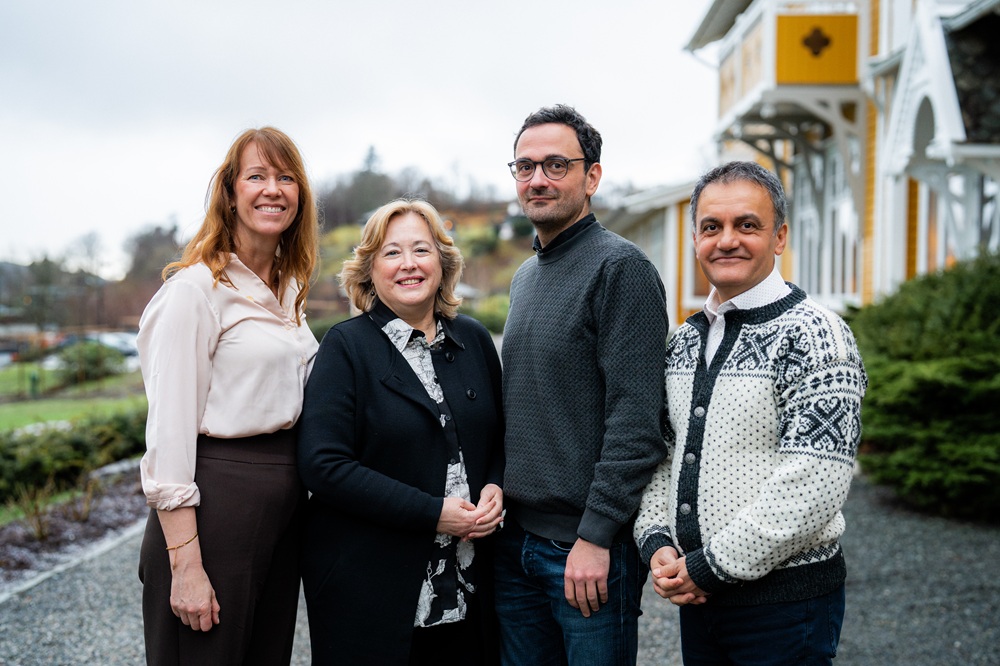
AI LEARN is an interdisciplinary and intersectoral effort led by UiB and NTNU. The Directors of AI LEARN, Professor Barbara Wasson from UiB and Professor Michalis Giannakos from NTNU, welcomed everyone and the AI LEARN Centre.
Professor Wasson went through the organisation of AI LEARN, introducing the centre management, the extended leader group, the AI LEARN board and Associated Partners ,as well as the work packages, while Professor Giannakos presented the research questions and objectives.
Professor Giannakos also asked such questions as “How can we work with AI?” and “What kind of new literacies are needed now that we are moving from chats to systems such as OpenClaw?”
The Impact of AI LEARN
Hiwa Målen, the Research & Innovation Leader of AI LEARN, then talked about the impact of the new centre. He underlined the grand ambitions and the size of the endeavour. Usually when a Centre is granted such a large sum of money he said, a congratulatory email or letter is received from the Research Council of Norway, but the six new national AI centres were considered so significant that there was a ceremony in Oslo, where Prime Minister Jonas Gahr Støre announed the funded centres.
Målen presented the overarching goal of the six AI centres, including AI LEARN, by quoting the Prime Minister: “Artificial intelligence is rapidly changing our society. We intend to have control over this development, understand the technology and use artificial intelligence to strengthen the welfare and the creation of wealth in Norway.”
Hiwa Målen also talked about how comprehensive the communication and inpact for AI LEARN will be, and how they cannot stick to the usual communication channels and AI LEARN has to think in new ways. Creating impact at the societal level has to go beyond dissemination as one-way communication.
Getting to Know the Consortium
Next, Alf Inge Wang, Professor in Game Technology and and Excellent Teaching Practitioner at the Department of Computer Science at NTNU, led an exercise where the goal was to get to know the consortium. Everybody had fun solving quizzes and puzzles about AI LEARN and its many partners on the game-based learning platform Kahoot!. There were also several chances to mingle and get to know the other participants in exercises where they had to go talk to three people they didn’t know already.
Kahoot! is a Norwegian limited liability company that was founded by Alf Inge Wang, Morten Versvik, Johan Brand and Jamie Brooker at NTNU in 2013. According to the company, the app is used by over a billion players every year at school, at work, and at home. Kahoot! is another of the 35 partners in the AI LEARN consortium.
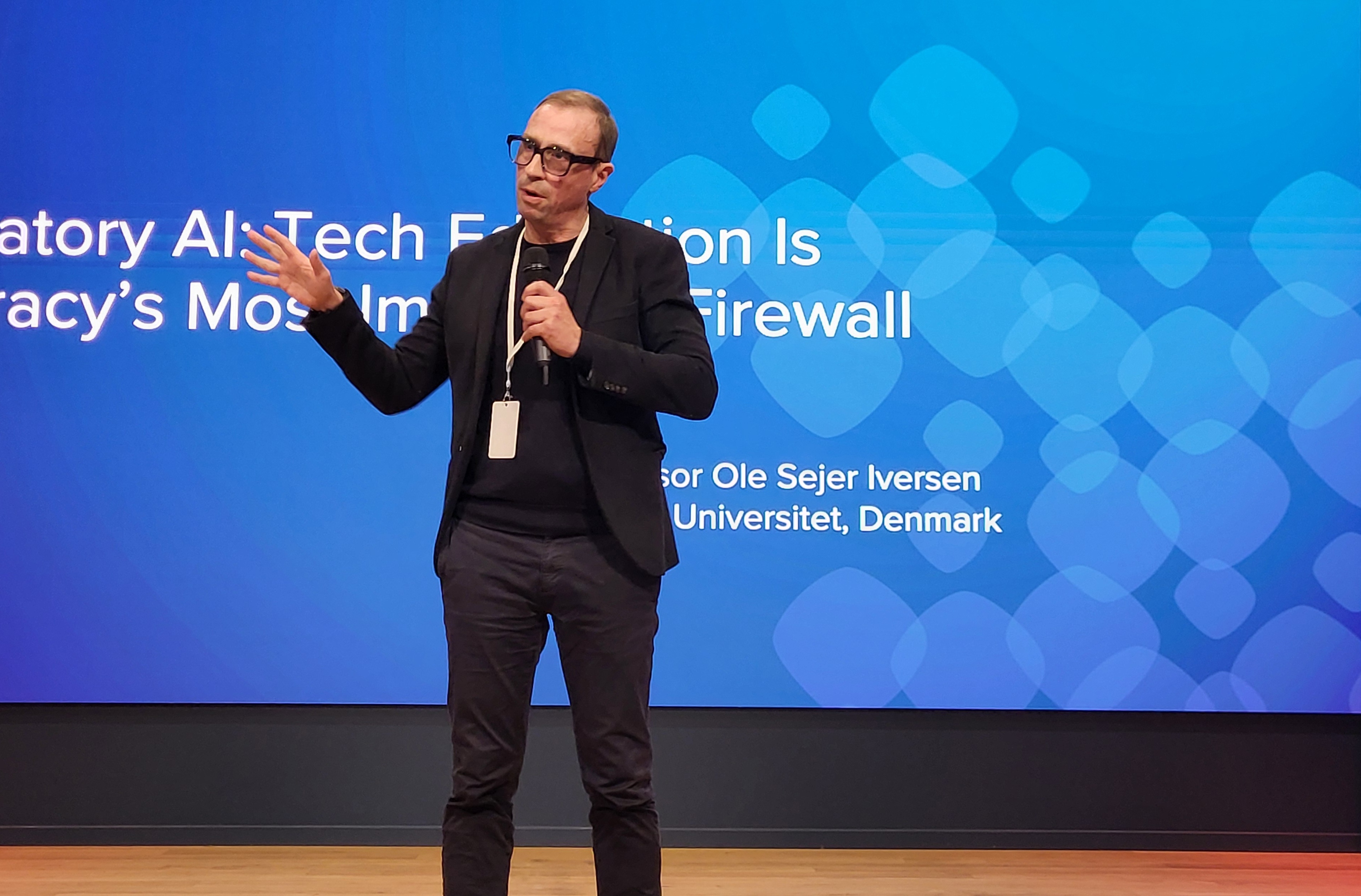
Participatory AI: Tech Education Is Democracy’s Most Important Firewall
The Keynote Speaker was Ole Sejer Iversen, Professor at the School of Communication and Culture at the Department of Digital Design and Information Studies, Aarhus University, Denmark. His areas of expertise are child-computer interaction, interaction design, AI literacy and participatory design.
Participatory AI means involving a diverse range of stakeholders in building AI systems, which might include members of the public, subject experts or intended end-users of the AI tool. Professor Iversen said that AI LEARN is about actually having a real impact, listening to people that are living their lives, and seeing what they need from AI. To him, AI LEARN is about developing something together, based on Nordic values, which is the opposite of what is currently going on with AI in the world today.
“It is our responsibility to ensure that people can legitimately participate in shaping AI technologies, even when the language and technical understanding are not yet in place”, remarked Professor Iversen.
Iversen talked about the work they’re doing with child-computer interaction at Aarhus University, by involving teachers and using The Engine Room, a tool for learning how AI works.
He told the Kick-Off participants how children and youth in Denmark have never learned a vocabulary to talk about or criticise the AI or algorithms that affect their lives, quoting a Danish high school student trying to appeal to politicians: «In school, we are taught more about the salt on the table than the algorithms controlling our lives”.
In Denmark, he said, 9 out of 10 students use AI to write school assignments, and 9 out of 10 of those who study subjects such as informatics, are boys, because girls are not encouraged to study these subjects at home or other places. Iversen said that it’s difficult to get politicians to take action regarding some of these AI-related challenges facing children, youth and teachers today. Therefore, he has contributed to creating an alliance between schools, tech companies and organisations in the educational sector where they can communicate with politicians on topics such as AI, learning and technology.
Considering the Future
Professor Iversen ended the keynote speech by leaving some questions for AI LEARN to consider:
• Who gets to shape the AI systems that will shape our societies? Will AI LEARN develop AI for society or with society?
• How will the centre enable citizens to participate in shaping AI? Not only as users or data providers, but as legitimate participants in imagining and designing AI futures.
• What participatory infrastructures will the centre help build? Across schools, professions, institutions and public debate where society learns to understand and shape AI.
• How will the centre scale participation beyond research projects? Through alliances, partnerships and public institutions so that participatory AI becomes part of society, not only academia?

The remainder of the first day of the Kick-Off included program posts such as getting to know the project clusters and the stakeholders of AI LEARN, before rounding off with a social event and dinner at VilVite. The program of the second day delved further into the project clusters.
Open Positions at AI LEARN
The first rounds of hiring at AI LEARN are underway, and several PhD positions have already been filled. However, more positions will be announced.
AI LEARN will be hiring PhD, Postdoc, and Researcher positions in a variety of fields at these locations: NTNU (Trondheim, Norway), University of Bergen (Bergen, Norway), University of Oslo (Oslo, Norway), and the University of Murcia (Murcia, Spain).
AI LEARN positions that are currently open:
• PhD Research Fellow in Education: Learning, Reading, and Assessment in the Context of Generative AI (Cluster 4 - Capacity Building, at the University of Oslo)


